
How to Communicate Revisions to Your Pattern Maker

Getting the perfect fit isn't just about how skilled your pattern maker is, but it’s about how collaborative and communicative you are in the process. You could hire the most expensive and well known pattern maker for your line, but if you aren’t able to clearly communicate your needs it will be a lot of money wasted. Your pattern maker is only as good as the feedback they receive from you.
It can be frustrating to spend not only lots of money, but lose time on a project that is not going well. However, as a professional pattern maker, I see a lot of reasons why the fit is sometimes missing the mark and I want to help make the revisions process easier for you!
Today I want to walk you through proven methods to ensure you are communicating exactly what you need so your vision can be realized.
Breaking the garment down into different intents
When you receive your first sample it’s an amazing moment. Finally your idea has come to life! You are excited and it’s perfect… for the time being. However, as you review it further you may realize there are some things that you just don’t like, aren’t happy with or want to change. At this moment, it can feel like a lot. It helps to step back and assess the different areas specifically:
Overall look: Does the garment look as you intended?
Proportions: Does the neckline, sleeves, length, etc.. match what you envisioned?
Fit: Is it too big or too small?
Oddities: Are there any areas that fit strangely?
Inconsistencies: Are there components that were misinterpreted or don’t sew together right?
With these five points in mind, it can help you to break down a potentially chaotic fitting.
When I used to work for a large retailer, my biggest pet peeve was to have to hunt down a designer to bring them into fitting a new garment where I really needed to know if the style was what they envisioned. Usually the first thing they would comment on was something obvious.
Designer: “oh, there’s extra fabric at the armhole!”
Me: “Yes, I know. I will resolve that because I know exactly what to do for it. But besides that, do you like the look? Is this garment what you envisioned?”
When working in a high volume environment like this, there are almost two different fittings going on at once and you maybe have 5-7 minutes to accomplish everything. I would be chatting with the fit model about mobility, how they felt, and determining where I needed to be with the final measurements for fit purposes. The design teams would be discussing the look, the fabric and how it came together. From here I’d compile my notes of what I needed to do and the design changes the designer wanted to make.
The point of my story is your pattern maker really and primarily wants to know about your vision. If you are working with someone new, it’s completely reasonable to point out everything to make sure it’s covered. Definitely mention all the concerns if you are working remotely to ensure you are both on the same page.
Word soup is ok
Can we just normalize the fact that you don’t need to know everything? You don’t need to apologize for the wrong words or terms. You don’t need to have any garment industry experience to be able to tell a good pattern maker what needs to be done. All you need are adjectives.
When putting together your own fitting notes, I know a lot of fashion designers try to make things as concise as possible. However, paring things down too much can change how your pattern maker interprets the feedback. For example, “The armhole is too big”. As a pattern maker my brain goes to a few follow up questions: Is it too low? Is it gaping? Is it too narrow and too much skin is showing?
With even another follow up sentence it can give me more clues into what is going on. If you are unsure of what the issue is, just try to describe it a few different ways to help get the message across.
Pictures & Videos
This one should be pretty easy and possibly the quickest way to get your intent across. If you are planning on sharing pictures with your pattern maker, it’s always a good idea to take photos during a fitting. Photos have a way of showcasing any discrepancies as though the volume is turned up 100%.
If you have a fit model, I would recommend taking front, side and back pictures, and it does not need to include the models head. If you are fitting on yourself, have someone help you out with pictures because selfies don’t always communicate what is happening.
When you are taking pictures it’s easy to fixate on just a problem area. I recently had a client send me a photo of a model having trouble moving her arms. Her arms were up above her head as though she was going to pitch a softball. However, from my POV I needed more information. I needed to see how the garment fit her when she was just standing regularly.
Another common scenario is when there is a problem area of the garment, let’s say a strange pulling at the waist seam. I will receive an extreme closeup of this problem and no other photos. The thing about pattern revisions is that sometimes the resolution comes from areas that you may not expect. A good pattern maker will know where to look and sometimes that involves needing to see the whole garment.
Videos are good, but I guess I’m old school and still prefer photos because you can put text on them and send them as email attachments that are easily referenced. However, if you do have a video, be mindful of size and how to view it. I worked with a tech designer who was chaos personified on a good day. When we first worked together she would send me WeTransfer links for videos. We were working on about 15 styles at once and none of the email links were titled as to what style they were and they expired very quickly. It took me so long to figure out what I needed to do. My advice is to use Dropbox to create a style specific folder and double check video file size. Now you, dear reader, may have other even more organized solutions.
Measurements
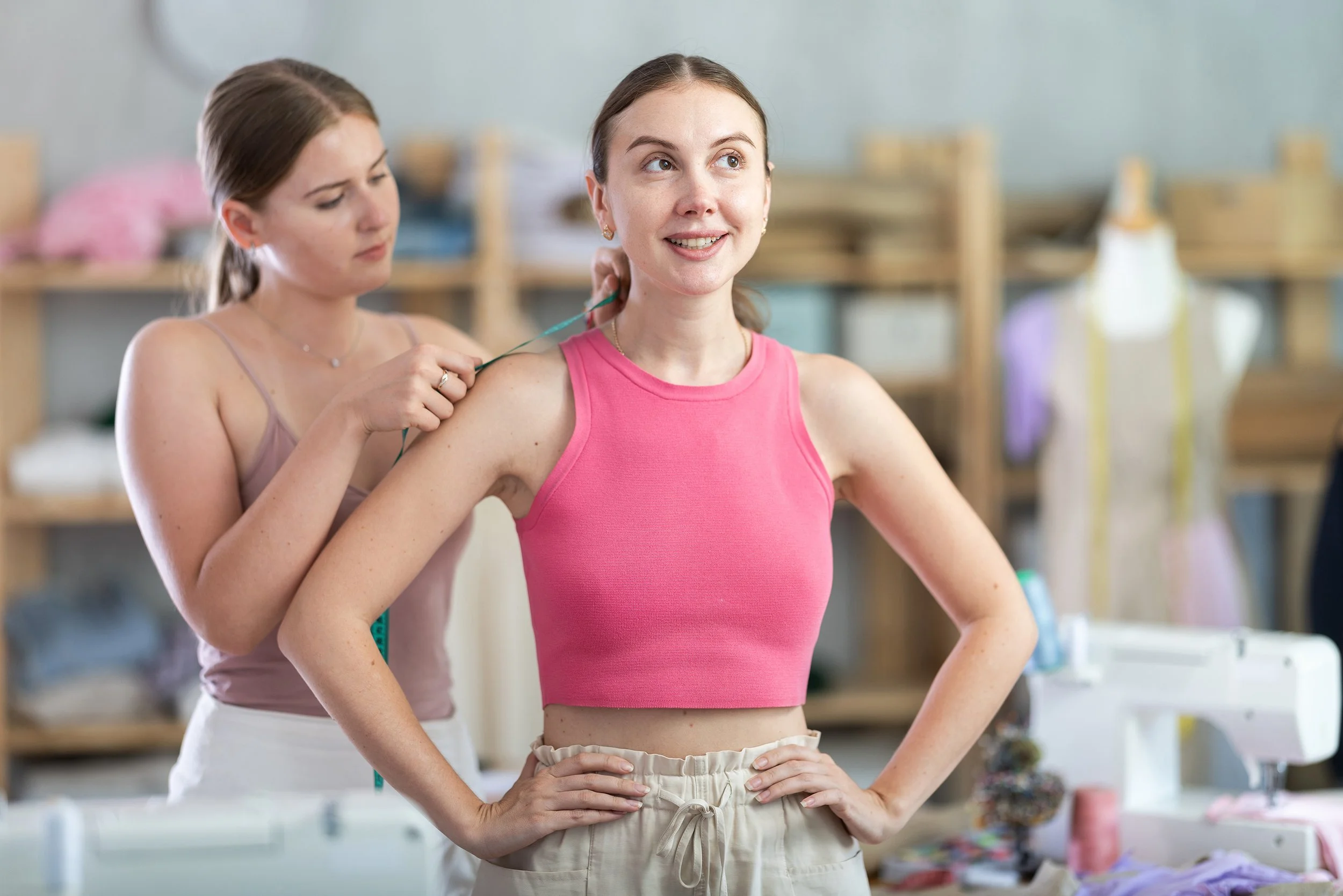
The number one way to ensure you are getting exactly what you want is to think in terms of measurements. If you want a dress shorter, say “take 4” off the length of the dress”. If the chest feels too big, how much would you pinch out to make it fit closer to what you are envisioning?
Let’s say you have an oversized blouse. Your pattern maker didn’t make it quite big enough. But you aren’t a technical designer. Heck, maybe you used to be an accountant or a graphic designer. How should you know what measurements it should be? The thing is you don’t have to have the 100% correct answer. You just need to give estimations.
Here is how these scenarios usually play out:
Designer: “It’s just not quite big enough. I want it a little more oversized.”
*fit comments end*
Pattern maker: “Hmmm. Let me look at the inspo pic again…Ok, maybe 4” in total will do the trick. Fingers crossed!”
Designer after receiving revised sample: “I’m really disappointed, it’s just not big enough! I’ve wasted time and money on this new sample. I’m going to have to find someone locally to do this for me .”
The thing is, even working with someone in person, you still need to be prepared with the information. Had the designer not checked out the follow up email would be, “approximately how much bigger do you think you want to go?”. Even with just the power of a tape measure it’s easy to give a pattern maker a better idea of what you are thinking. It doesn’t need to be exact— whatever helps communicate your intentions.
Additionally I think this is a good place to mention the importance of clarity. Can we all agree to just never use words like “smidge”, “a touch,” or even “just a little more”. These words just create too much opportunity for vague interpretations. When you are on your third sample and your factory needs to start production tomorrow, don’t tell your pattern maker to shorten the sleeve “a touch”. Be direct: “Shorten the sleeve 1”.”
3 things I want to say about revisions
1. Revisions are part of the process
Don’t be discouraged if your garment is not 100% as it should be the first time you receive a sample. This is par for the course of apparel product development. In the best case scenario, I would plan for three fit samples to be made. Even with established relationships and fitting systems this is how it generally plays out. The first fit sample can be a major makeover and fit notes are extensive. At this point the pattern may undergo a major transformation. The second fit sample is pretty close to what it should be. There may be some new fit issues to address, but they should be minor. Perhaps small adjustments are made to the design. The third fit sample should be pretty much spot on. This should represent what your production should look like and it’s your confirmation.
Now, this scenario is what happens on a good day. There could be extenuating circumstances that require a 4th or even 5th fit sample (let’s hope not though!) But things do happen. Just don’t take it all the way to 10 fit samples though, lol!
2. Your patternmaker doesn’t give the fit approval
I hope the one thing you can take from this post is that it’s important to communicate and you don’t have to be a technical expert to do so. Anyone can communicate their design vision using basic communication skills. If you are new to fitting garments you may feel uncertain and perhaps unqualified. But I assure you that you are! You know what you want and what the garment should be so if it doesn’t look or fit like you want it to, you are the one to make that call.
I used to work with a designer who would end all her recorded fittings with a long sigh and “ok, that’s it for me. Let me know if this looks ok and if you think we can grade it.” This sounds completely harmless, but I felt very vulnerable always being put into the situation of determining whether a style was approvable or not. She could easily come back to me later and blame me for something not being right (which she did).
Pattern makers are facilitators for the fit and engineering of a garment. Fit standards vary considerably based on each designer's point of view. For example, I have a client that doesn’t even want to do fittings. Just make the pattern and grade it and it’s always fine. Then I have another client that will torture me through 6 fittings until every possible tiny wrinkle is smoothed from a bodice. Would I, as the pattern maker, handle these two clients' projects fit approvals differently? Absolutely, but it’s not my call.
3. New relationships can be challenging
If you never tell your pattern maker what you don’t like, what doesn’t look the way it should, or how you think something should be, then how will they know? Your pattern maker is not a psychic.
Too often I find this situation in brand new relationships. If you are working with a new pattern maker for the first time, they don’t know you, you don’t know them and your communication styles can be a bit misaligned. This is normal and it takes a bit of collaboration to get on the same page.
I’ve been here myself many times where I miss the mark on what the designer wanted, but then they take the time to explain how what I provided doesn’t match and then it’s a lightbulb moment for me! Things click and then I can reproduce what they want. So many of my long term client relationships have started this way. Walking away based on the first fit is a bit wasteful, in my opinion.
Your relationship with your pattern maker should be thought of as a long term investment. It can feel like a lot of work to make sure someone sees your designs exactly the same way as you do. But when things click, it’s just a magical thing!